
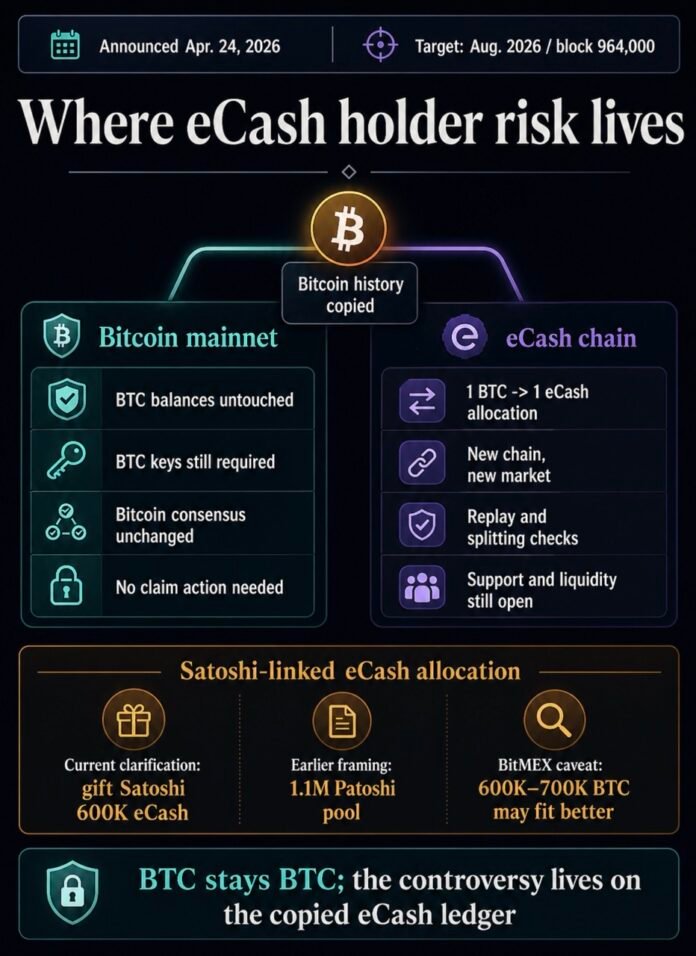
Paul Sztorc, LayerTwo Labs CEO and longtime Bitcoin developer, is planning an August 2026 Bitcoin hard fork called eCash, targeted around Bitcoin block 964,000.
His April 24 announcement described a new chain that would copy Bitcoin history, give holders 1 eCash for every 1 BTC at the split, and launch with a Bitcoin-Core-like base layer mined with SHA-256d alongside Drivechain-style sidechains.
For ordinary Bitcoin holders, the practical question is more specific than the backlash. The fork can create a new asset, new confusion, and new operational decisions, while BTC balances remain governed by Bitcoin software, Bitcoin consensus, and Bitcoin private keys.
In a later clarification, Sztorc said the current eCash plan would give Satoshi Nakamoto 600,000 eCash rather than 1.1 million eCash. He also repeated that BTC balances are untouched by eCash and that moving BTC always requires Bitcoin software plus the relevant Bitcoin private key.
That distinction sets the holder map. A Bitcoin holder can ignore a fork and still keep the same BTC.
The unresolved issue is whether eCash becomes a supported asset that exchanges, wallets, custodians, miners, and tax records have to process. Until that happens, the controversy is mostly about legitimacy, incentives, and precedent on a new ledger.
What eCash would copy from Bitcoin
The proposed chain starts from a familiar hard-fork mechanic. At the fork height, Bitcoin history would be copied into a new network.
A wallet holding 4.19 BTC at the split would have 4.19 eCash on the new chain, according to Sztorc’s announcement. Holders could keep, sell, or ignore those coins if the new chain launches and if they can safely access them.
The base-chain pitch is intentionally close to Bitcoin. Sztorc described the eCash layer 1 as a near-copy of Bitcoin Core, mined with the same SHA-256d algorithm, with a one-time difficulty reset to its minimum value at launch.
He also said the chain would activate BIP300 and BIP301 through CUSF, a route meant to bring Drivechain-style sidechains into eCash without changing Bitcoin itself.
The Drivechain component should stay in the background for holders. BIP300 describes hashrate escrows for sidechains, while BIP301 describes blind merged mining, a design under which SHA-256d miners can collect revenue from other chains without running those chains’ full software.
Those mechanics explain why Sztorc wants a separate eCash network. BTC remains governed by Bitcoin mainnet rules.
Code readiness is a separate threshold. The public LayerTwo Labs CUSF enforcer repository showed active development, while LayerTwo Labs’ download page offered BitWindow software related to the Drivechain stack.
Final eCash launch software, replay rules, and user-grade splitting tools still need verification before ordinary holders can treat the fork as operational.
Preserving BTC requires no claim action during the proposal phase. Holders can leave seed phrases private, avoid importing keys into new software, and ignore claim pages while the chain remains unlaunched.
The chain has to exist first, then the ecosystem has to decide whether it will recognize the forked coins. That sequencing is the difference between a theoretical allocation and a usable asset.
Those same practical gates determine whether the 1:1 allocation becomes anything more than a paper balance in a copied ledger.
The Satoshi allocation fight lives on the new chain
The controversy grew out of the initial funding design. Reporting and Sztorc’s own post described a plan to manually reassign fewer than half of the eCash coins corresponding to the presumed Patoshi-pattern coins, often framed around 1.1 million BTC, to early investors or supporters.
The Bitcoin mainnet coins would stay where they are. The dispute is over whether a fork should edit the copied version of those balances before launch.
Sztorc’s latest clarification sharpens that point instead of removing it. He says eCash would gift Satoshi 600,000 eCash rather than 1.1 million, a figure closer to the lower Patoshi estimate than the common million-plus framing.
That still leaves the core objection. A straight 1:1 copy would assign every copied coin to the same keys that held the BTC at the split, while the current eCash proposal would choose a different treatment for part of the dormant copied balance.
Bitcoin’s social contract treats signatures and private keys as the boundary of control. A new chain can choose different rules, but a chain that reallocates dormant copied coins tells users something about how its own ledger treats old balances.
Critics see that as a precedent problem. Sztorc has argued that a pure fork can leave contributors undercapitalized before launch, creating a chain that starts as a zombie project.
The size of the Satoshi-linked pool also deserves care. BitMEX Research found strong evidence of a dominant early miner, but argued that the evidence is less robust than the common million-plus framing suggests.
Its analysis said 600,000 to 700,000 BTC may be a better estimate than roughly 1 million or 1.1 million. That means the exact denominator behind any eCash reassignment claim is uncertain.
Earlier coverage described a possible version that did not involve Satoshi’s coins. The later Sztorc clarification supplied for this update points to a different current posture: Satoshi would receive 600,000 eCash, while BTC itself remains outside the fork’s control.
The eCash project site and related Satoshi Half-Airdrop material is still moving through public clarification rather than a final release package.
| Claim | Current read | Holder consequence |
|---|---|---|
| BTC holders receive eCash 1:1 on the forked chain | Sztorc’s announcement and current coverage describe that allocation | A claimable asset may exist, subject to safe access and market support |
| BTC balances move on Bitcoin mainnet | The fork would create a separate chain while BTC remains under Bitcoin consensus | BTC stays under Bitcoin keys and Bitcoin mainnet rules |
| Satoshi-linked eCash allocation | Sztorc now says Satoshi would receive 600,000 eCash rather than 1.1 million | Legitimacy and precedent risk sits on the new chain |
| Replay protection and coin splitting are ready | Sztorc says default eCash software should block eCash spends from replaying on Bitcoin; final tooling still needs verification | Holders should wait for trusted wallet or exchange guidance |
| Major infrastructure support exists | Reviewed sources did not establish major miner, exchange, custodian, or wallet support | Liquidity and usability remain open tests |
The holder checklist starts with replay and custody
A fork becomes operational when people try to move coins. Replay protection is central because a transaction valid on one chain can sometimes be copied to another chain after a split.
Contentious forks without replay protection can expose exchanges and holders to replay attacks, according to Coinbase’s hard-fork guidance.
Sztorc’s replay clarification said default eCash software should block an eCash spend, such as a sale, from replaying on Bitcoin. He also said moving BTC may also move the corresponding eCash, and that behavior could depend on the software a holder uses.
That leaves a simple behavioral rule. Holders should avoid random claim tools, unofficial wallets, and links that promise early access.
A badly designed splitter, a malicious wallet, or a phishing site can create more risk than the fork itself. The safer threshold is public guidance from reputable wallets, exchanges, and custodians after final code and replay behavior are visible.
Custodial holders face a different decision tree. Large platforms tend to evaluate forked assets case by case, using security, liquidity, developer activity, roadmap, compliance, and engineering workload as filters.
Coinbase has described that approach in its own fork policy. That is the lens to apply here.
Even if eCash launches, a platform holding BTC for customers may decline to support the forked asset, may support withdrawals only, or may delay access until the network is stable.
Tax treatment adds another layer for US holders. Under IRS Revenue Ruling 2019-24, a hard fork without receipt of new cryptocurrency does not create gross income, while a hard fork followed by an airdrop can create ordinary income when the taxpayer receives units and has dominion and control.
For eCash, that means the tax answer may depend on whether the holder can actually access, transfer, sell, or otherwise dispose of the forked coins. It is a professional-advice question, especially for coins held through exchanges or custodians.
Miner support is the first infrastructure signal because the new chain needs security and block production separate from Bitcoin’s own social consensus. Exchange support is the next signal because a forked coin with no venue, no withdrawals, and no market depth has little practical use for most holders.
Wallet and custodian policies sit beside those two signals. They determine whether ordinary users can see, split, move, or ignore the forked asset without taking on unnecessary key-management risk.
Names and market scale add another source of confusion
The proposed fork also runs into name overlap. There is already an eCash network with the ticker XEC, maintained around Bitcoin ABC software.
The existing XEC asset traded near $0.00000704 with a market capitalization around $140.9 million on April 28, 2026. Separately, Cashu describes itself as a free and open-source Chaumian ecash protocol built for Bitcoin.
That overlap has practical consequences. Search results, fake support pages, copied tickers, and social links can blur the difference between Sztorc’s proposed fork, the existing XEC asset, and Bitcoin ecash tools such as Cashu.
The right user response is boring and important: verify domains, tickers, wallet instructions, and exchange notices before interacting with any fork-related asset.
The scale difference is also useful. BTC traded around $76,824.95 on April 28, with a market capitalization near $1.54 trillion and 59.9% dominance.
Any eCash fork would be trying to attach a new asset and a contested rule set to the largest crypto network by market value. That scale raises the bar for infrastructure support because even small confusion around Bitcoin balances can draw significant attention.
The fork’s first test is therefore external to the argument over Satoshi’s coins. It needs code that users can inspect, replay behavior that wallets can trust, a splitter that works, miners willing to secure the chain, exchanges willing to list or process it, custodians willing to explain their policy, and enough liquidity to give the forked coins a market price.
Until those pieces appear, ordinary holders have little reason to act. Their BTC remains BTC.
The risk today is mostly informational: mistaking eCash for Bitcoin, mistaking one eCash for another, or treating an evolving launch proposal as an asset they must immediately claim.
If the infrastructure arrives, the question changes. Holders would then need to decide whether to claim, split, sell, hold, or ignore the forked coins, and custodial platforms would need to explain how they handle customer entitlements.
The Satoshi-coin controversy would still be a fight over the legitimacy of the new chain. The holder risk would become operational.