
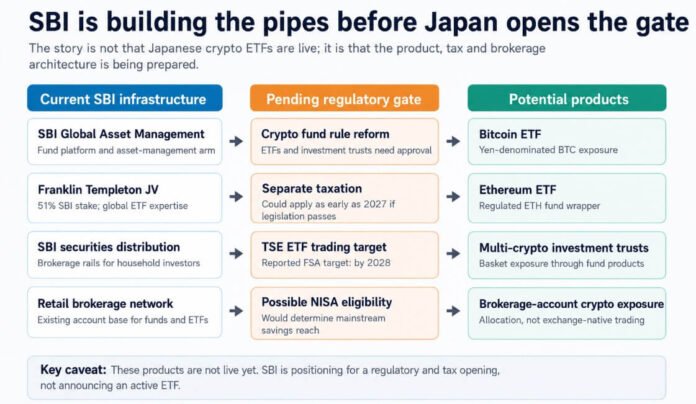
SBI Group has told investors that its asset management arm plans to launch ETFs focused on Bitcoin and Ethereum, as well as investment trusts that hold baskets of multiple crypto assets, once Japan reforms its rules on crypto funds and taxation.
SBI has already built the architecture through a joint venture with Franklin Templeton, established product categories, and set an AUM target of $31.5 billion within three years of launch.
SBI Global Asset Management Group’s AUM exceeded $75.5 billion at the end of March 2026, with the company holding a 51% stake in the Franklin Templeton venture and managing a broader securities business with AUM exceeding $415 billion.
The crypto ETF products would plug into that distribution network upon arrival, the kind that already routes millions of Japanese households into equities, bonds, and mutual funds.
The FSA reportedly aims to enable crypto ETF trading on the Tokyo Stock Exchange by 2028, and separate taxation could apply as early as 2027 if related legislation passes.
Why Bitcoin ETF Japan demand matters
Bank of Japan data show that Japanese households held $14.8 trillion in financial assets at the end of 2025, of which 48.5% was held in cash and deposits.
The government has spent years pushing households toward investment, and Japan’s tax-favored investment wrapper, NISA accounts, reached 28.26 million accounts and $447 billion in purchases by the end of 2025.
Reaching SBI’s $31.5 billion target would require an allocation rate of just 0.21% of total household financial assets.
Japanese crypto accounts have already reached approximately 14 million, nearly half the number of NISA accounts, with customer assets exceeding $31.5 billion.
Chainalysis recorded Japan’s on-chain value received up 120% in the 12 months to June 2025, the strongest growth among top APAC markets. A fund wrapper would route that existing demand through the brokerage and securities platforms where Japan’s broader household savings already sit.
Hong Kong launched Asia’s first spot Bitcoin and Ethereum ETFs in April 2024, establishing the regional precedent.
Japan would enter with a distinct structural advantage with a far larger domestic savings pool, an entrenched retail brokerage culture, and major financial institutions that already manage everyday investment behavior for millions of households.
The US spot Bitcoin ETF approval in January 2024 gave Bitcoin access to Wall Street balance sheets, registered investment advisers, and institutional custody.
Japan’s version would give Bitcoin access to yen-denominated brokerage accounts, fund supermarkets, conservative household portfolios, and a tax-favored savings infrastructure that already routes millions of ordinary investors into equity and bond funds.
US ETF flows made US trading hours the dominant regulated demand window, and Japanese ETFs would add a yen-denominated, Asia-hours flow channel as a second regulated layer with its own institutional buyers, custody providers, and brokerage incentives.
What has to happen first
Proposed reforms could bring Japan’s crypto gains from the current 55% ceiling to 20%, matching the rate applied to stock trading.
SBI’s May 2026 deck says that separate taxation could be implemented as early as 2027 if legislation passes. A regulated ETF with a 20% tax ceiling becomes a portfolio product.
Beyond taxation, the products require regulatory approval for ETF and investment-trust structures, custody frameworks, benchmark construction, market-maker depth, and a decision from regulators about whether crypto funds can qualify for NISA-style tax-favored accounts.
That last question could determine whether crypto exposure reaches the same households currently buying domestic and foreign equity index funds through their NISA allocations.
Open savings rail or regulatory delay?
In the bullish case, crypto funds receive 20% tax treatment and gain eligibility for mainstream long-term brokerage accounts by 2027, and SBI and Rakuten launch products across their combined distribution networks.
The $31.5 billion target falls within the three-year window, drawing from 14 million existing crypto account holders and from brokerage investors who would never open a crypto exchange account.
Japan joins Hong Kong as a regulated source of Asia-hours ETF flows, and Bitcoin’s demand base broadens into a second major currency and time zone.
Chainalysis’ 120% on-chain growth figure points to domestic appetite already building, and the ETF wrapper routes it through securities infrastructure and into mainstream portfolio allocations.
For the bearish case, ETF and investment-trust rules slip past 2028, and tax reform delivers a framework that excludes crypto funds from NISA accounts.
Products launch with a high-risk classification, keeping them off mainstream brokerage platforms and out of tax-favored accounts, and SBI reaches $3.1 billion to $12.6 billion, mostly from existing crypto-native users migrating to a regulated wrapper.
Asia’s regulated crypto narrative stays centered on Hong Kong and offshore trading venues, and the Franklin Templeton JV produces a credible product that reaches only a narrow, already crypto-native audience.
| Scenario | What has to happen | Three-year AUM outcome | Market impact |
|---|---|---|---|
| Bull case: open savings rail | 20% tax treatment, ETF/trust approval, mainstream brokerage distribution, possible NISA-style access | ~$31.5B+ | Japan becomes a major Asia-hours regulated Bitcoin flow channel |
| Bear case: regulatory delay | ETF rules slip past 2028, crypto funds excluded from NISA, high-risk classification limits distribution | ~$3.1B–$12.6B | Products mostly serve existing crypto-native users; Hong Kong/offshore venues remain central |
SBI has built the product architecture to address a regulatory opening that Japan’s regulatory calendar has set in motion.
The people who could move meaningful capital into Bitcoin exposure in Japan may be the same people who hold $7.2 trillion in cash deposits and already use NISA accounts to buy index funds.
An ETF wrapper, favorable tax treatment, and brokerage distribution would give those investors a familiar path, which is what SBI is building now.