
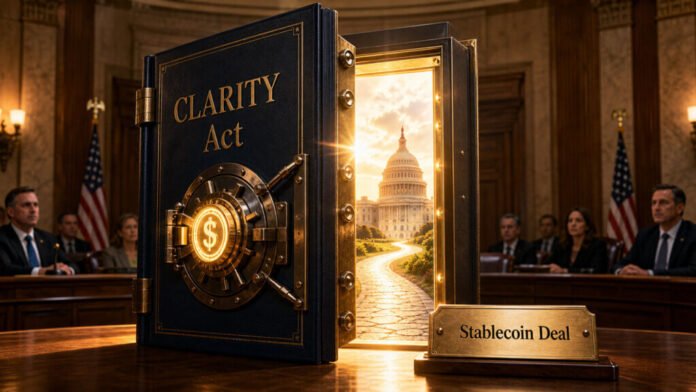
The CLARITY Act is finally moving toward a long-awaited Senate Banking Committee markup next week, but its path is being complicated by a fight over whether Congress should impose new ethics restrictions on federal officials and elected leaders involved with the crypto industry.
On May 7, crypto journalist Eleanor Terrett reported that the draft text of the crypto market structure bill had circulated among industry participants ahead of a potential committee vote.
According to her, the language is still being revised, with Democratic priorities expected to shape additional changes before the panel acts.
This move marks the clearest sign in months that Senate negotiators are trying to revive the CLARITY Act, which would define when digital assets fall under the Securities and Exchange Commission (SEC) or the Commodity Futures Trading Commission (CFTC).
Yet the bill’s return to the committee calendar has also exposed a new fault line, with Democrats considering whether to withhold support unless strong ethics language is included to curb President Donald Trump’s family crypto interests before the bill leaves Banking.
The dispute threatens to shift the debate away from the technical details of market structure and toward a broader political fight over presidential conflicts, investor protection, and whether Congress should advance a major crypto bill while Trump-linked ventures remain active in the market.
Democrats press for ethics language
According to Politico, Democratic negotiators are weighing whether to oppose the bill unless the Banking Committee version includes provisions governing how federal employees and elected officials engage with digital assets.
Sen. Ruben Gallego of Arizona, who has led Democratic ethics discussions, reportedly indicated that the issue should be addressed in the committee-approved text rather than left to a later floor amendment.
However, Republicans have argued that such language falls outside the Banking Committee’s jurisdiction and should be handled later in the legislative process.
That procedural divide is now central to the bill’s prospects. Republicans say they are open to adding ethics restrictions before final passage. Democrats are wary that delaying the issue could allow the bill to advance without firm conflict-of-interest guardrails.
Sen. Elizabeth Warren, one of the crypto industry’s most prominent Democratic critics, has framed the issue in direct terms. On May 7, she said:
“The Trump family crypto project quietly cashed in while regular investors got stuck holding the bag. Any crypto legislation that doesn’t shut down this presidential corruption and protect investors isn’t worth the paper it’s written on.”
The demand places Democrats who have been open to crypto legislation in a difficult position. Supporting the bill could help deliver the regulatory framework the industry has sought for years.
However, advancing it without their preferred ethical language could expose them to criticism that they helped legitimize a market that benefits Trump’s family while leaving conflicts unresolved.
Why are Democratic lawmakers focused on their ethics demands?
The ethics fight has gained force because of the scale and visibility of Trump-linked digital asset activity.
Over the past year, World Liberty Financial and other crypto ventures associated with Trump’s family have become a recurring flashpoint in the debate over crypto legislation.
A report released last year by congressional Democrats alleged that the president has used his office to advance his personal financial interests, citing crypto holdings worth as much as $11.6 billion and an estimated $800 million in income from digital asset sales in the first half of 2025 alone.
The report also raised national security and conflict-of-interest concerns regarding foreign entities and state-linked actors investing heavily in these ventures.
Furthermore, Democrats argue the administration has systematically rolled back federal oversight to benefit industry donors.
The report highlighted the dissolution of the Department of Justice’s National Cryptocurrency Enforcement Team (NCET) and alleged that the administration intervened to halt federal investigations into major firms, including Coinbase, Gemini, Robinhood, Ripple, Crypto.com, Uniswap, Yuga Labs, and Kraken.
While Republicans dismiss the report as politically motivated, the allegations form the basis of the Democrats’ refusal to advance the CLARITY Act out of committee without explicit safeguards against executive conflicts of interest.
Banks’ lobbying efforts against stablecoin rewards remain
Apart from the ethics language demand, the CLARITY Act also continues to draw sharp opposition from the traditional financial sector over stablecoin yields.
The banking fight had been one of the largest policy barriers to a Senate Banking Committee markup before lawmakers reached a compromise earlier this month.
The bill had stalled amid disputes over stablecoin rewards, decentralized finance provisions, software developer protections, and the balance of authority between the SEC and CFTC.
Coinbase CEO Brian Armstrong withdrew support for an earlier draft, citing concerns that the language could undercut parts of the crypto industry it was meant to regulate.
However, the bill’s momentum improved after Sens. Thom Tillis and Angela Alsobrooks reached a compromise on stablecoin-yield language. The proposal would bar crypto firms from offering rewards that function like interest on bank deposits while preserving room for incentives tied to customer activity, platform usage, or spending.
That distinction helped bring the legislation back within reach of a committee vote. Crypto firms viewed the compromise as a way to avoid a blanket ban on customer rewards, while supporters argued it addressed banks’ central warning that stablecoins could become deposit-like products outside the traditional financial system.
The agreement, however, did not end the lobbying fight. It shifted the dispute to the details of what counts as prohibited yield and what remains a permissible customer reward.
As a result, a coalition of banking trade groups, led by the American Bankers Association (ABA), has argued that the draft still leaves open the possibility for exchanges and other intermediaries to offer rewards linked to account balances, customer tenure, or membership programs.
Banks say those incentives could encourage customers to hold idle funds in stablecoins rather than insured deposits, weakening the funding base lenders use to support mortgages, small-business credit, and community lending.
For traditional financial institutions, the concern is that crypto platforms could compete for deposit-like balances without being subject to the same banking rules.
However, Tillis has rejected the criticism, saying the compromise reflects months of negotiation and directly addresses the risk that stablecoin rewards could mimic bank interest.
Still, the banks’ opposition adds another layer of pressure on negotiators, even if it is no longer the only source of risk.
What’s next for the CLARITY Act?
Despite all of these oppositions to the bill, supporters of the CLARITY Act are trying to keep the bill on schedule by arguing that the political case for action is now stronger than the case for delay.
A HarrisX survey of 2,008 registered voters conducted May 1-4 found that 52% supported the CLARITY Act after receiving a neutral description, while 11% opposed it.
The poll also found that 70% of voters said the US should already have passed clear crypto legislation, and 60% preferred federal legislation over case-by-case enforcement.
These findings give pro-crypto lawmakers and industry advocates a counterweight to the pressure from banks and Democratic ethics demands.
Alex Thorn, head of research at Galaxy Digital, said the polling showed support across party lines for congressional action. He said:
“Democrats, Republicans and independents, people across the spectrum want Congress to pass CLARITY and they want them to pass it now.”
Sen. Cynthia Lummis, a pro-crypto lawmaker, has also warned that further delay could push US crypto activity offshore.
That urgency is colliding with a narrow legislative calendar that could be impacted by the upcoming midterm elections. The administration and Republican allies have pushed to have the bill reach President Donald Trump’s desk by July 4, aligning the market-structure effort with the country’s 250th anniversary.
Sen. Bernie Moreno has framed the target date in sweeping terms, saying:
“On July 4th we will celebrate the 250th anniversary of America’s revolution and it will also be the beginning of America’s financial revolution.”
But the path remains difficult even if the Senate Banking Committee advances the bill. The measure would still need to clear the full Senate, be reconciled with the House version, and win final approval before reaching the president.
At the same time, lawmakers must bear in mind that nearly half of voters (47%) said they would consider voting for a candidate outside their preferred party if that candidate supported the CLARITY Act, a figure that jumps to 72% among cryptocurrency owners.
Considering this, the coming markup will be a test of whether months of negotiation have produced a coalition strong enough to survive both banking industry resistance and Democratic demands for conflict-of-interest safeguards.
For crypto firms, the vote could determine whether Congress is still on track to deliver the federal market structure framework the industry has sought since the collapse of FTX.
For Democrats, it could determine whether that framework advances with ethics guardrails strong enough to defend in an election year.