
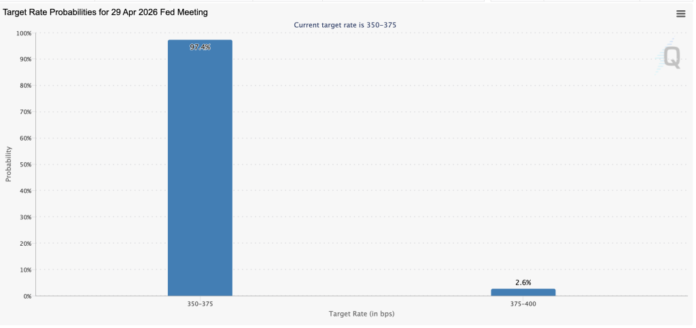
The U.S. 10-year Treasury yield dropped nine basis points to 4.35% Monday after Fed Chair Jerome Powell told a Harvard University audience that inflation expectations remain “well anchored” – enough to pull rate-hike odds from 25% to 5% in a single session.
What it wasn’t enough to do was stop WTI crude from closing at $104.80, its first settle above $100 since 2022, dragging the Nasdaq down 0.75% and Bitcoin back to $66,500 after briefly threatening a breakout.
The market is being pulled in two directions simultaneously. Powell is telling it rates are fine. Oil is telling it inflation isn’t over. One of those signals will break first, and which one it is determines the next directional leg for crypto.
- Fed Signal: Powell’s Harvard comments sent CME FedWatch rate-hike odds tumbling from 25% to 5% for 2026, with the 2-year yield sliding eight basis points to 3.83%.
- Oil Level: WTI crude rose 5.3% Monday to close near $105 per barrel – the first close above $100 since 2022, sustained by the ongoing US-Iran conflict.
- Crypto Impact: Bitcoin shed early gains and settled around $66,500, roughly flat on the 24-hour, as risk appetite compressed across equities and digital assets.
- Rate Path: The March 18 FOMC held the federal funds rate at 3.5%–3.75% for a second consecutive meeting, with the SEP projecting one quarter-point cut in 2026.
Powell Buys the Bond Market Time – But the Oil Clock Is Still Running
Powell’s Harvard remarks landed precisely where the bond market needed them. The Fed, he said, is looking past near-term oil shocks and anchoring policy to inflation expectations rather than headline energy prints – which is exactly what traders positioning for imminent rate hikes did not want to hear.
The 10-year yield’s nine-basis-point decline and the 2-year’s eight-basis-point drop confirm the message sent clearly.
The mechanism is straightforward: lower rate-hike odds reduce the opportunity cost of holding zero-yielding risk assets, which is structurally supportive for Bitcoin.
When CME FedWatch reprices from 25% to 5% hike probability, that is a material shift in the discount rate applied to speculative assets. Under normal conditions, that move alone would have sent BTC meaningfully higher.
But rising U.S. real yields on 10-year TIPS remain an active headwind. Even with nominal yields falling Monday, the structural argument that Powell is merely deferring a harder decision – not resolving it – kept institutional desks cautious.
As Powell himself acknowledged at Harvard, “We will eventually maybe face the question of what to do here. We’re not really facing it yet because we don’t know what the economic effects will be.” That framing is honest. It is also, in trader terms, a conditional green light with an expiration date attached.
Lon Erickson of Thornburg Investment Management noted the Fed “appears comfortable with current economic conditions, higher oil prices, and geopolitical concerns notwithstanding” – a comfort level that looks reasonable until energy markets force a reassessment.
Discover: The best pre-launch token sales
Oil at $105 Is Hitting Crypto Through Three Compounding Channels
The oil pressure is not a single variable – it operates through three simultaneous transmission channels, and that is what makes the current setup more dangerous than the headline WTI print suggests.
First, inflation re-acceleration. WTI above $100, sustained by the US-Iran conflict blocking normal Middle East supply flows, directly pressures headline CPI.
The Fed’s stated comfort with “anchored expectations” depends on those expectations not moving – and energy at these levels historically tests that anchor. Powell has already acknowledged inflation has lingered above 2% for five years post-pandemic without fully stabilizing. A persistent $100-plus oil regime challenges the assumption that the current rate hold is sufficient.
Second, delayed rate cuts. The FOMC’s March SEP projected one quarter-point cut in 2026. When oil is running a macro shock through the system, that single projected cut starts to look optimistic. Every week WTI holds above $100 extends the timeline for easing, which extends the drag on leveraged long positioning in crypto.
Third, geopolitical risk premium. The Iran conflict is not a clean supply shock with a visible resolution timeline. It is an open-ended variable that keeps institutional desks in defensive positioning. Bitcoin ETF outflows have already signaled that capital is rotating defensively – and sustained geopolitical uncertainty gives institutions no reason to reverse that posture.
That combination – inflation re-acceleration risk, delayed easing, and persistent geopolitical drag – is the one traders are underweighting when they read Powell’s Harvard comments as categorically bullish.
Bull and Bear: What Bitcoin Needs to Resolve This Setup
Right now the whole market is stuck in a tug of war between Powell and oil, and Bitcoin is just reacting to whoever wins that fight.
If Powell leans soft at the late April FOMC meeting and oil cools off, especially if it drops back under $95, that takes pressure off inflation and gives Bitcoin room to breathe, which is where a move back toward $70K starts to make sense, especially if ETF flows pick up again.
But that is not the reality yet. What we have instead is mixed signals everywhere, oil holding elevated levels, the Fed staying vague, and Bitcoin chopping in a wide range between roughly $63K and $68.5K with no real direction.
That $63K level is the one that matters. As long as it holds, this is just consolidation. If it breaks, things can slide fast.
The real trigger now is inflation data and oil. If rising oil starts feeding into inflation again, the Fed gets pushed back into a tighter stance, and that is where risk assets struggle. If oil cools and inflation stays under control, the pressure eases, and Bitcoin gets its shot higher.
So it all comes down to one thing, oil versus the Fed, and until that tension breaks, everything else is just noise.
Explore: Best crypto assets to diversify your portfolio
The post Fed’s Powell Soothes Bonds but Rising Oil Pressures Crypto and Stocks appeared first on Cryptonews.