
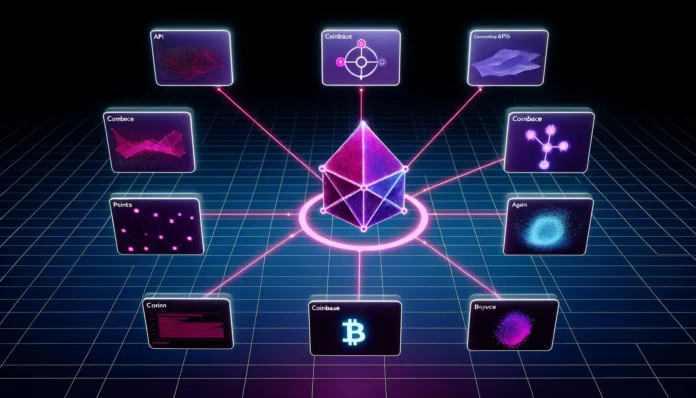
Coinbase has launched Agent.market, an AI agent app store built on its x402 payment protocol, embedding permissionless stablecoin rails directly into AI infrastructure across seven service categories. As of April 21, 2026, approximately 69,000 active AI agents on x402 have already processed over 165 million transactions totaling $50 million in volume, figures that frame this as an infrastructure play, not a speculative product launch.
The core question now: whether Agent.market can become the default discovery and payment layer for autonomous AI agents, or whether fragmented developer ecosystems blunt adoption before the rails gain critical mass.
Key Takeaways:
- What x402 is: An open payment protocol named after the unused HTTP 402 status code, enabling instant stablecoin micropayments over HTTP for APIs, apps, and AI agents – no accounts or subscriptions required.
- What Agent.market adds: A permissionless app store spanning seven categories – reasoning, data, media, search, social, infrastructure, and trading – with providers including OpenAI, Bloomberg, CoinGecko, AWS Lambda, and Coinbase RAT.
- What AI agents can now do: Autonomously discover, pay for, and chain together services using Agentic Wallets, without developer-preset API keys or manual billing setup.
- Payment rail: USDC stablecoins on Base, with Coinbase’s Payments MCP enabling LLMs including Anthropic’s Claude and Google’s models to access blockchain wallets via x402.
- Backing: The x402 Foundation, incubated under the Linux Foundation, counts over 20 institutional backers including Cloudflare, Stripe, AWS, Google, Visa, Circle, and the Solana Foundation.
- Watch item: Google’s agentic payments protocol integration with x402 for single-tap USDC retail transactions – a signal that could accelerate volume materially.
Discover: The best crypto to diversify your portfolio with
How Coinbase x402 Agent.market Actually Works – and Why the Architecture Matters
x402 was designed around a structural gap in the existing web: the HTTP 402 status code has existed since the early internet as a placeholder for payment-gated content, but was never implemented at scale.
Coinbase built x402 to fill that gap. When an AI agent hits a payment-required endpoint, x402 handles the USDC micropayment over HTTP instantly, without redirecting to a billing portal or requiring a pre-negotiated API key relationship.
Agent.market operationalizes that mechanic into a browsable catalog. Service providers can list without permission, which directly reduces the setup friction that has historically limited API commerce: x402 creator Erik Reppel stated the protocol “is reshaping customer acquisition activation costs for businesses, as robots can now access services at a very low setup cost without needing API keys.”
That framing matters; it redefines cost-of-acquisition for AI-facing businesses from human onboarding flows to machine-readable price discovery.
The seven-category structure – reasoning, data, media, search, social, infrastructure, and trading – maps directly onto what autonomous agents need to chain multi-step tasks. An agent could pull financial data from CoinGecko, process it through an OpenAI reasoning endpoint, execute a trade via Bankr, and log the transaction through QuickNode infrastructure, with every handoff settled in USDC on Base without human authorization at each step.
If adoption follows the arc of prior API marketplaces, the trading and data verticals will see volume concentration first – they carry the highest per-call value and the most time-sensitive payloads.
The failure mode to watch is latency and settlement finality at scale. x402’s prior 165 million transactions represent an average call value under $0.31 – the architecture is calibrated for micropayments, not bulk settlements. Whether it holds throughput as agent complexity and chain length increase is the open engineering question.
Discover: The best pre-launch token sales