
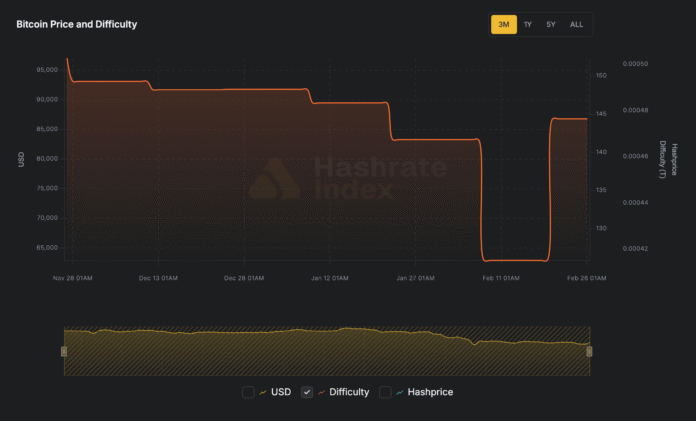
Bitcoin difficulty just reset about 15% higher to roughly 144.40T.
While this is neither the first nor the last, it is the largest since around 2021. The timing is important because the protocol tightened miner economics while Bitcoin has been chopping around the mid-$60,000s with repeated tests near $65,000.
When blocks arrive faster than the ten-minute target, the network raises the work required per block to normalize issuance. That mechanism is working as designed, with security improved, block timing normalized, and production costs moved higher in one adjustment.
For markets, the key detail is what a difficulty increase does when price and fees don’t rise alongside it.
In that case, mining stops behaving like background infrastructure and starts behaving like a flow variable, because the fastest way to close a near-term cash gap often involves selling coins into spot markets. The setup is mechanical, but it can matter for short-run price behavior after an adjustment, especially when the weaker segment of the fleet reaches the same stress zone at the same time.
Why this matters now
Difficulty functions as a cost multiplier. A higher multiplier raises the work required to earn the same expected share of blocks, which translates into more electricity consumed and more wear per expected coin for a given machine, unless miners offset it through a higher Bitcoin price, higher transaction fees, lower power costs, or higher efficiency.
Hashprice is the clean shorthand for the combined result. It expresses revenue per unit of hashrate, typically quoted in dollars per petahash per second per day. Around the adjustment window, hashprice fell from roughly $33.5 to about $29.7 per PH/s/day, which puts a meaningful portion of the fleet in a band where outcomes depend heavily on power costs, machine efficiency, and debt service.
Nonetheless, that level doesn’t imply uniform distress.
The strongest operators pair low-cost power with modern fleets and financing that preserves flexibility, while less efficient miners operate closer to break-even. This is especially true in a post-halving environment where the block subsidy is smaller, and fees have to do more work during quiet periods.
The point is simpler: the margin for error shrank quickly, and tighter weekly math can translate into more price-facing supply when operators meet liquidity needs through inventory sales.
Why a difficulty jump into flat revenue compresses margins
Higher difficulty means more hashes are required to earn the same expected output, and the adjustment arrives all at once. Miners respond through efficiency upgrades, cost renegotiation, balance-sheet financing, or coin sales, yet those channels move on different clocks.
Treasury sales sit on the shortest clock. Power and hosting agreements often behave like fixed obligations. Hardware upgrades require capital and deployment time. Capital markets can tighten when Bitcoin and miner equities weaken together.
When difficulty rises while price stays range-bound, the stress shows up as a cash-flow constraint.
Revenue in fiat terms can compress immediately, while most operating costs stay denominated in currency and electricity. Profitability can deteriorate even as network security strengthens, and that combination tends to surface as miner-related sell pressure, especially among operators with scheduled payments.
How a miner squeeze turns into scheduled selling
When revenue per hash declines, miners typically work through cost reductions, efficiency improvements, capital raises, and coin sales, but the order in which they do it is shaped by time. The bills that arrive next week take priority over projects that pay back in six months.
Public miners carry payroll, site leases, hosting bills, and interest expense. Many also hold BTC on their balance sheets as a form of working capital. These treasury coins become the most direct liquidity source when other channels look expensive or slow. A miner that needs dollars on a schedule sells into that schedule, and the transaction turns a balance-sheet asset into spot market supply.
Markets pay attention to sellers who transact on obligation rather than preference, because the flow tends to arrive during indecisive price action, when financing windows narrow and reserves matter more. Selling can also cluster, since similar cost structures and similar fleet efficiencies can push multiple operators into the same stress zone at once.
The effect can persist for a while because a softer price reduces dollar revenue per block, which can increase the number of coins required to cover the same fiat bill.
This mechanism doesn’t require a network crisis. It emerges from a mismatch between a higher work requirement on the protocol side and a market that does not reprice bitcoin higher.
What ends the squeeze, and why the base case still skews constructive
A forced-seller window typically closes through price strength, fee strength, or difficulty relief, and each channel works through a different part of miner revenue.
Price strength is the fastest. Even a moderate move higher improves miner revenue in fiat terms immediately, while many costs remain relatively stable, which reduces the need to fund operations through coin sales.
Fee strength is a second relief valve. Transaction fees can rise with congestion, activity spikes, or volatility-driven on-chain demand. That top-up can turn a red week into a manageable one even if spot price stays range-bound.
Difficulty relief arrives through the protocol. If enough miners power down, block times slow, and the next adjustment can reduce difficulty. A large upward move, like 144.40T, can be followed by a downward move if the fleet contracts.
From here, the outlook splits into two coherent paths that follow from the same inputs.
In the weaker path, price continues hovering around $68,000 without follow-through, hashprice stays near the $30 per PH/s/day zone, and a portion of the fleet funds operations by selling treasury coins. That adds supply into moments when spot markets already lack momentum, which can keep price action heavy for longer than sentiment expects.
In the constructive path, a combination of modest price improvement, a sustained fee pickup, or incremental difficulty relief reduces cash-flow pressure, and the selling impulse cools.
The constructive bias rests on a straightforward observation: a large difficulty increase reflects a deep mining base that is adding hashrate and normalizing block times quickly, even in a post-halving margin environment.
Difficulty at 144.40T signals the network can absorb industrial-scale compute and preserve cadence, which tends to strengthen the security profile over time.
Squeezes also act as clearing events. Hashrate share migrates toward operators with durable power strategies, modern fleets, and flexible financing, while less efficient miners renegotiate costs, consolidate, or power down. The network emerges with a higher-quality production base.
A miner selling phase can also function as a distribution phase, where coins move from leveraged producers into the hands of buyers willing to hold through volatility. The market can dislike the flow in real time while still building a sturdier holder base under the surface.
The clean way to read this moment is to separate fundamentals from flow: fundamentals improved through higher difficulty and stronger security, while flow risk increased as a range-bound price meets tighter miner economics.
What to watch next week
If the market is going to feel this adjustment, it will show up through a small set of observable constraints.
Hashprice matters because it concentrates the revenue picture into a single number, and sustained prints around the $30 per PH/s/day region sharpen the difference between miners who can fund operations from current revenue and miners who need to monetize inventory.
Price behavior around $65,000 is relevant because range-bound action can amplify the effect of scheduled selling, while a cleaner move higher tends to relax the cash-flow constraint quickly.
Fees matter because a fee-heavy period can supplement the post-halving revenue base.
Difficulty is worth focusing on because the next adjustment will reflect whether enough operators powered down to slow blocks and trigger relief.
In practice, the question is arithmetic. Miners either pay the power bill from current revenue, or they convert bitcoin to do it, and that conversion becomes supply that can lean on spot markets for as long as the constraint stays binding.