
The European Union is racing against a self-imposed deadline to implement its side of the existing US-EU trade accord, with the next formal trilogue round set for May 19 in Strasbourg.
President Donald Trump threatened on May 2 to lift tariffs on EU cars and trucks to 25% from 15%, a move the Kiel Institute for the World Economy estimates could cost Germany nearly €15 billion in near-term output.
Bitcoin’s exposure to this trade fight runs through US inflation, Federal Reserve policy, and cross-asset risk appetite.
The European Parliament advanced the implementing legislation on Mar. 26, subject to a sunrise clause tying EU tariff cuts to US compliance, a sunset clause ending concessions on Mar. 31, 2028, and a suspension mechanism if Washington breaches the deal or if US imports surge.
Some EU governments have resisted those conditions as too restrictive, preferring faster implementation with fewer safeguards. Parliament’s chief trade negotiator Bernd Lange said on May 7 that there is “still some way to go.”
The deal would remove duties on US industrial goods and open preferential access for some American farm and seafood exports, while the EU side would receive capped tariffs of 15% on qualifying goods, a rate Trump now threatens to replace with 25% on autos.
| Date | Event | Why it matters for markets |
|---|---|---|
| Mar. 26 | European Parliament advances implementing legislation with sunrise, sunset, and suspension safeguards | Shows the deal is moving, but with political conditions attached |
| May 2 | Trump threatens to raise EU auto tariffs to 25% from 15% | Turns the trade story into a live inflation and risk-off threat |
| May 7 | Bernd Lange says there is “still some way to go” | Signals the deal is progressing, but not done |
| May 19 | Next formal trilogue round in Strasbourg | Main negotiation deadline for near-term market expectations |
| May 28 | Next U.S. PCE inflation release | Key test of whether tariff fears are feeding back into Fed expectations |
The macro bridge to Bitcoin
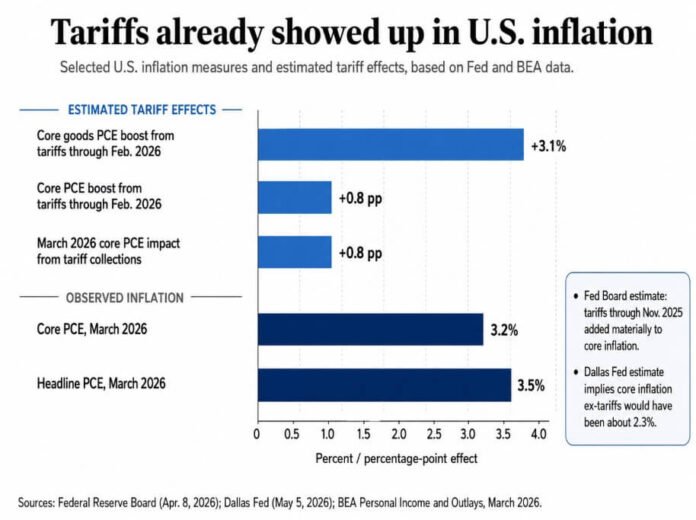
A Federal Reserve Board note from Apr. 8 estimated that tariffs implemented through November 2025 raised core goods PCE prices by 3.1% through February 2026 and lifted core PCE overall by 0.8%.
Dallas Fed research published May 5 corroborated that figure using a different methodology, estimating that tariff collections raised 12-month core PCE inflation in March 2026 by approximately 0.8%. The results implied that core inflation, excluding tariff effects, would have been around 2.3%. Headline PCE for March 2026 stood at 3.5% year over year.
Those numbers show that the 2025 tariff wave added measurably to core inflation, even as the Fed held rates at 3.5%-3.75% on Apr. 29 and described inflation as still elevated.
San Francisco Fed research found that a 10% tariff increase can initially compress demand enough to lower headline inflation before goods inflation peaks roughly 1.2% points higher in year two, and services inflation follows about 0.6% points higher in year three.
That non-linear path creates the kind of ambiguous macro signal that can keep the Fed on hold longer than markets expect, removing the easing-cover risk that assets need.
For Bitcoin, a Fed that holds longer translates to tighter dollar liquidity and less room for the speculative risk appetite that has historically supported BTC rallies.
IMF research found that a single common “crypto factor” explains 80% of crypto price variation and that Bitcoin and Ethereum volatility became 4 to 8 times more correlated with major US equity indices versus the pre-pandemic period, which is linked directly to the entry of institutional capital.
The Kiel Institute estimates long-term German output losses of around €30 billion from the threatened tariff hike, at a moment when forecasters expect Germany to grow only 0.8% this year.
A European growth scare alongside US inflation anxiety creates a cross-market mix that can trigger a broader de-risking pulse, affecting Bitcoin as it trades with elevated equity correlation.
What to expect
If Parliament and member states resolve their safeguard dispute and Washington backs away from the 25% auto threat, the tariff overhang fades as a near-term macro variable.
| Scenario | Macro effect | Fed implication | Likely BTC read-through |
|---|---|---|---|
| Deal progresses, 25% threat fades | Less inflation anxiety, less trade stress | More room for markets to price future easing | Mild risk-on relief |
| Talks drag, no clear resolution | Ongoing uncertainty | Fed stays cautious, headlines matter more | BTC becomes more headline-sensitive |
| 25% tariff threat becomes credible or takes effect | Higher inflation fear + weaker EU growth | Lower odds of cuts, tighter macro backdrop | Risk-off pressure on BTC |
Inflation anxiety eases at the margin, and Bitcoin can participate in a broader risk-on response if equity markets and rate-cut expectations stabilize.
ETF inflows, regulatory news, and internal market structure retain greater direct weight on Bitcoin’s medium-term price direction, but removing a macro headwind in a month when the next PCE release is scheduled for May 28 creates a cleaner setup for risk assets broadly.
If the auto tariff rises to 25%, or markets price that outcome as credible, the sequence is less favorable. Goods inflation gets a new upward input in an environment where core PCE already runs at 3.2%, and the Fed has no current basis for cutting.
Weaker German growth adds a global slowdown dimension to the inflation worry. Bitcoin, trading with the elevated equity correlation the IMF documented, would absorb the risk-off move from the growth scare and the reduced odds of Fed easing due to stickier inflation.
The asset can hold or recover, but the macro wind turns against it, and the May 28 PCE print would land as a referendum on how much the tariff threat has already passed through to prices.
Crypto-specific catalysts, such as ETF inflows, spot market structure, and regulatory news, exert a more direct influence on Bitcoin’s medium-term price action.
If tariff escalation reignites inflation anxiety just as markets expected disinflation to resume, May could become another month in which the Fed’s calendar takes precedence over crypto’s internal momentum.
The May 19 negotiation round and the May 28 PCE release are the two dates that can either confirm or close that risk window.