
X has given users a new way to turn down the noise in their For You feeds. The first signal from that tool should make the crypto industry uncomfortable.
According to X product executive Nikita Bier, crypto ranked as the most-snoozed topic since the platform began rolling out topic snoozing for Premium subscribers. It came ahead of politics, sports, business and finance, artificial intelligence, gaming, and entertainment.
That is a brutal placement for an industry that has spent more than a decade treating X as its main public square. Crypto has used the platform for launches, price discovery, fundraising narratives, protocol drama, scam warnings, meme cycles, customer support, and real-time market consensus.
For many users, that same feed has become exhausting.
The strongest signal in Bier’s ranking is plain: when given the option, many users chose to see less crypto before almost anything else.
Bitcoin’s price makes the timing sharper. CryptoSlate’s Bitcoin market data showed BTC near $76,000 on April 30, down over 24 hours and seven days, yet still up more than 14% over 30 days.
That is enough of a rebound to put Bitcoin back into daily market conversation. It is also far below the October 2025 all-time high above $126,000, which leaves a large gap between the market’s recent recovery and the public’s tolerance for more crypto content.
Crypto’s biggest attention venue is becoming easier to escape
The most important part of X’s change is the user action. Crypto became the first thing users chose to mute when the platform gave them more control over their feeds.
High visibility can look like demand from inside the crypto industry. From the user side, it can feel like repetition, spam, bots, recycled charts, promotional accounts, and a stream of posts that all ask for attention at once.
X’s new product direction makes that fatigue more measurable. The platform has begun rolling out Custom Timelines, which let Premium users pin topic feeds to the home tab.
Those feeds are powered by Grok’s understanding of posts and the platform’s personalization systems. At the same time, X is giving users a way to snooze topics from the For You tab.
One tool pulls committed users deeper into a niche. The other helps tired users fence that niche off.
For crypto, that creates a split distribution system. The already-convinced can pin crypto and go deeper.
The fatigued can mute it and move on. The group in the middle, the ordinary user who checks Bitcoin now and then, becomes harder to reach by accident.
That middle group has always been important to retail cycles because many new users first encounter crypto through ambient social exposure. They see a chart, a warning, a meme, a debate, or a price milestone, then search for context.
If the feed removes more of that ambient exposure, crypto loses one of its cheapest discovery channels.
The risk is larger for the broader crypto market than for Bitcoin itself. Bitcoin has institutional products, ETFs, treasury buyers, long-term holders, and macro allocators.
It can attract capital through financial rails that do not require a casual user to enjoy crypto content on X. Meme coins, token launches, smaller chains, influencer-led trades, and narrative-driven altcoins depend more heavily on social spread.
They need users to see a theme before they search for it. They need the feed to carry excitement before fundamentals can be tested.
If crypto becomes something users actively mute, that mechanism weakens.
This also turns spam into a market-structure issue. Bier has said that no technology can fully solve spam replies on crypto accounts and the majority of crypto activity is bot-driven.
That figure should be treated as an attributed platform claim instead of a verified measure of all crypto discussion. Even with that caution, the direction is clear.
Users are reacting to an experience. If crypto content feels polluted, the feed becomes less useful for education, price discovery, and trust formation.
Bitcoin can recover while public attention keeps thinning
The uncomfortable part for the industry is that Bitcoin’s recovery and crypto fatigue can happen at the same time. Markets do not need every casual user to feel excited before price can move.
Capital can return through ETFs, fund flows, macro positioning, treasury strategies, or long-term accumulation. Attention works differently.
It depends on curiosity, trust, and the willingness to keep reading after the first few seconds.
Recent fund-flow data supports the idea that capital is moving on a separate rail. CoinShares reported weekly inflows of $1.4 billion into digital asset investment products, the strongest weekly total since January and a third consecutive week of positive flows.
That gives Bitcoin a support channel that social media sentiment alone cannot explain. Institutional and product-based demand can improve while casual-feed tolerance gets worse.
That is the core contradiction.
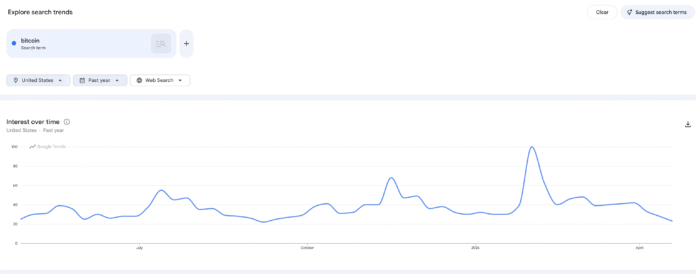
Google Trends adds another layer. Trends data is normalized on a scale from 0 to 100, so it shows relative interest inside a selected window rather than absolute search volume.
The recent worldwide chart for “bitcoin” over the past three months shows a spike followed by a steady fade into April. The five-year view is more mixed, with several strong bursts around major market moments. The current period is also far below the 2017 mania peak.
That does not prove public interest has disappeared. It shows that current search intensity is weaker than past peaks and softer than the recent spike.
In plain English, Bitcoin is back on the market radar, while the surrounding content layer has yet to rebuild broad curiosity at the level that usually marks full retail participation. That aligns with the X snooze data.
Users may still care about Bitcoin’s price. They may still own exposure.
They may still follow major milestones. They are also showing signs of fatigue with the surrounding content machine.
CryptoSlate previously covered a related tension when US Bitcoin search interest climbed toward 2021 levels even as Bitcoin traded far below its later highs. The lesson from that earlier period was that search interest is a receipt for attention, rather than a price signal by itself.
The current setup carries a different implication. Price can rebuild before the public mood does.
That leaves Bitcoin in a stronger position than most of crypto because it can draw demand from more than one source. It also leaves the industry with a more difficult task: proving that the content layer is worth returning to.
The next cycle may depend on who can still reach normal users
The next phase for crypto may be less about whether people know Bitcoin exists and more about whether they want crypto in their daily information diet. Awareness is no longer scarce.
Trust and tolerance are.
That is a different problem from the early cycles, when the main challenge was explaining what Bitcoin was. The current challenge is explaining why a user should keep crypto in the feed after years of scams, leverage blowups, celebrity tokens, exchange failures, spam replies, and AI-generated content farms.
That shift has practical consequences. If Bitcoin holds the $70,000 to $80,000 area and fund inflows continue, it can keep behaving like a macro asset even with weak social enthusiasm.
That would support the idea that Bitcoin has matured into a capital market instrument with its own institutional demand base. Under that path, casual users may return only after price forces the issue, which would make retail a lagging signal rather than the engine of the move.
A second path is more difficult for the broader market. Crypto remains one of the most-muted topics, search interest stays soft, and altcoin narratives fail to break into general feeds.
That would leave Bitcoin relatively insulated while smaller assets fight for attention inside narrower, more self-selected audiences. The effect would show up in weaker exchange app momentum, slower narrative spread, thinner retail participation, and more dependence on paid promotion or influencer networks.
In that environment, social reach becomes more expensive and less trusted at the same time.
A third path is more selective. X’s Custom Timelines could create a smaller but more committed crypto audience.
Users who pin crypto may engage more deeply with higher-intent content, while everyone else sees less of it. That would reward serious analysis, market data, protocol updates, and trusted media.
It would punish generic hype because generic hype would struggle outside its own bubble. The open question is whether that smaller audience can still create market-wide momentum or whether it simply produces stronger echo chambers.
The fourth path is a trust backlash. If bot complaints and spam claims keep defining the crypto experience on X, the platform may tighten reply visibility, topic distribution, or paid controls.
Users may begin treating crypto posts as unsafe by default. That would have the heaviest impact on projects that rely on fast social legitimacy.
It would also create an opening for search, newsletters, direct media brands, exchange research desks, and data platforms because users still need context, even when they do not want the firehose.
The clearest thing to watch is whether crypto stays near the top of X’s snoozed-topic ranking after the launch period. A one-week ranking can be dismissed as novelty, exposure bias, or a power-user quirk.
A persistent ranking would say something deeper about the state of crypto distribution. The second signal is Bitcoin search behavior if BTC approaches $80,000 again.
A sharp search rebound would show that price can still pull ordinary users back in. A muted search response would suggest that Bitcoin’s recovery is being driven more by capital flows than public excitement.
Crypto’s feed problem is now part of the market
The industry has often treated attention as proof of strength. That assumption needs more scrutiny.
A topic can be everywhere and still be unwanted. A feed can be full of crypto and still fail to build trust.
A market can recover while the public chooses to see less of the content around it.
The X snooze ranking is powerful because it turns a vague complaint into a user action. People used a new tool to reduce crypto in their feeds.
That is a clearer signal than sentiment slogans because it reflects behavior. For a market that still depends heavily on social distribution, behavior carries more weight than another poll, another influencer fight, or another chart thread.
Many users are tired.
They may be tired of scam replies under major accounts. They may be tired of tokens promoted with no substance.
They may be tired of market panic dressed up as certainty. They may be tired of seeing every price move converted into a demand for attention.
When a platform gives those users a switch, they use it.
Bitcoin can continue attracting capital through ETFs and institutional products, especially if macro conditions support hard-asset narratives or if investors keep treating BTC as a liquid, high-beta store-of-value trade.
The rest of crypto faces a harder distribution test. Projects that need broad retail discovery may find that the old X playbook produces less reach and more resistance.
Exchanges may need to rely more on search intent, product utility, brand trust, and direct acquisition. Media outlets may gain leverage if users still want crypto context but want less feed sludge.
Global adoption data also argues against treating X fatigue as a verdict on crypto demand. Chainalysis’ 2025 Global Crypto Adoption Index ranked India and the United States at the top, showing that crypto usage remains geographically broad and driven by different local needs.
CryptoSlate has also covered how adoption often depends on practical on-ramps, payment rails, verification flows, and usable interfaces rather than online attention alone. The feed is one channel.
It is an important channel because crypto has leaned on it so heavily, but it is still one channel.
Ultimately, X shows that crypto’s free-attention layer has been damaged.
Bitcoin has enough institutional structure to keep moving even when social enthusiasm looks tired. Many other crypto assets still need that enthusiasm to travel.
The next cycle may reveal which parts of the market can survive a world where users can make crypto disappear from their feeds with one tap.