
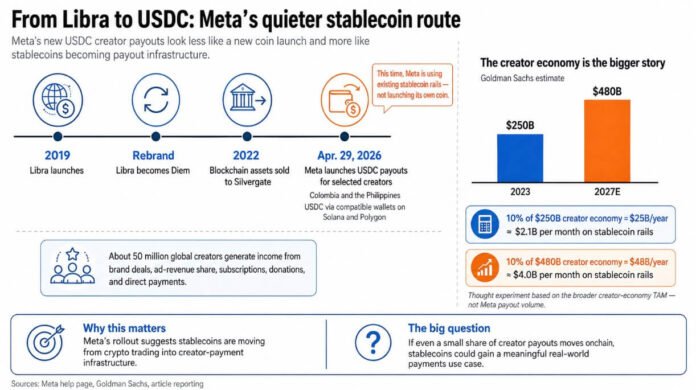
Libra launched in 2019, rebranded to Diem, and sold its blockchain assets to Silvergate Bank in 2022, three years of work that ended when regulators pushed back, and bank partners withdrew.
On Apr. 29, Meta announced USDC payouts to eligible creators through compatible crypto wallets on Solana and Polygon, starting with selected creators in Colombia and the Philippines.
Meta is plugging creator payouts into dollar-stable rails that Stripe, Circle, and others have spent years building. The current rollout asks eligible creators to connect a compatible wallet and receive USDC directly from Meta’s creator payout system.
Goldman Sachs pegged the creator economy at roughly $250 billion in 2023 and projected it could reach $480 billion by 2027, spanning roughly 50 million creators whose income flows from brand deals, platform ad revenue shares, subscriptions, tips, and direct payments.
Goldman found that brand deals account for about 70% of creators’ revenue, meaning most creator income flows through business-to-creator payment pipelines.
A 10% slice of a $250 billion creator economy represents $25 billion annually, roughly $2.1 billion per month, flowing over stablecoin rails. By 2027, 10% of Goldman’s projected $480 billion market puts that figure at $48 billion annually, or $4 billion per month.
These TAM scenarios are pegged to the broader creator economy’s total payment flow and calibrate the scale of what this pilot could open up at modest penetration rates.
According to a BIS report, payment-related stablecoin flows in 2025 reached roughly $390 billion. The amount is distinct from the $35 trillion in total on-chain stablecoin volumes, most of which are for trading and settlement.
A $25 billion to $48 billion annual creator economy flow would equal between 6.4% and 12.3% of all current real economy stablecoin payments, large enough to visibly move the real-payments share of stablecoin activity if adoption materializes.
Why the infrastructure is ready
The Libra window closed partly because stablecoin infrastructure did not exist at scale.
Stripe now explicitly markets stablecoin payouts as practical for creators, freelancers, and remote teams, offering USDC on networks including Solana and Polygon, the same chains Meta chose, with KYC/AML onboarding and reach into more than 60 countries.
Stripe says stablecoin cross-border payments settle in minutes. Businesses in 101 countries previously unsupported by Stripe Treasury can now hold dollar-denominated balances and move money across stablecoin rails.
A platform that runs USDC payouts can reach a creator in Manila or Bogotá faster and with less friction than a traditional wire transfer, while settling the transaction in dollars.
The choice of Colombia and the Philippines traces to that logic, since both markets combine meaningful creator economies with real-world friction in cross-border payouts and demonstrated appetite for dollar-denominated savings.
Because roughly 98% of stablecoins are dollar-denominated, any meaningful expansion of creator payouts over these rails would effectively move more internet income onto dollar infrastructure. This is digital dollarization of the internet labor market, settling cross-border creator income in dollars with fewer intermediaries between the payer and the creator.
Meta’s own help page language walks creators through compatible wallets, blockchain network choices, and security steps, far from the interface a typical brand-deal creator would navigate without guidance.
Stripe flags the same friction, noting that assets sent across incompatible chains can vanish without recourse, and apparent low transaction costs can rise once on-ramps, off-ramps, compliance overhead, and local exchange conversion are factored in.
The BIS frames the macro version of that same problem when noting that out of the $35 trillion in total stablecoin volumes in 2025, only $390 billion traced to real-economy payments.
Paths for stablecoins in the creator economy
In the bull case, wallet abstraction advances quickly enough that creators receive USDC the way they receive Venmo payments, while off-ramps in key markets become cheap and instant.
In that setup, the 10% scenario looks conservative. Once a major platform normalizes stablecoin payouts, gig platforms, affiliate networks, brand deal intermediaries, and subscription tools all have an incentive to offer the same option.
Creator payments would become one of the first large non-trading stablecoin categories, and the real-payments share of stablecoin activity would grow in a way that cannot be explained by crypto-native volume alone.
In the bear case, wallet confusion and off-ramp friction keep crypto-native adoption at bay. Meta’s pilot stays a niche feature for creators who already hold digital assets or who work in corridors where payout speed and dollar access justify the friction of managing a wallet.
The BIS’s $390 billion real-payments estimate is the best evidence for that path. The rails exist, but mainstream adoption has not kept pace with the infrastructure behind them.
| Factor | Bull case | Bear case |
|---|---|---|
| Wallet experience | Wallet abstraction improves enough that creators receive USDC with a near-invisible crypto layer | Creators still have to manage wallets, networks, and security steps themselves |
| Off-ramp quality | Off-ramps become cheap, fast, and reliable in key payout markets | Cash-out remains expensive, slow, or operationally confusing |
| Who adopts first | Mainstream creators, gig workers, affiliate earners, and subscription-based creators begin opting in | Mostly crypto-native creators or users in niche high-friction payout corridors adopt |
| Stablecoin payout volume | The 10% TAM scenario looks conservative as more platforms add the same option | Volume stays limited and concentrated in small pilot programs |
| Effect on real-payments stablecoin share | Creator payouts become one of the first large non-trading stablecoin categories and lift the real-payments share materially | Stablecoins remain dominated by trading and settlement, with only modest real-economy payment growth |
| What Meta’s pilot becomes | A model other platforms copy across creator tools, marketplaces, and payout systems | A niche feature that proves infrastructure exists but not mainstream demand |
| Cross-border payout impact | Faster dollar-denominated settlement meaningfully reduces friction for creators in markets like Colombia and the Philippines | Traditional payout rails remain more familiar and trusted despite being slower |
| Dollarization effect | More internet income moves onto dollar-denominated stablecoin infrastructure | Dollar stablecoins stay a marginal option rather than a default payout rail |
| Main constraint | Execution and scaling | User friction and limited abstraction |
| Deciding variable | The wallet disappears from the user experience | The wallet remains visible and burdensome for ordinary users |
Between those two outcomes, the deciding variable is abstraction. If the wallet disappears from the user experience, adoption follows commerce, and the creator economy becomes a real-world stress test for stablecoins.
If creators have to manage private keys and choose networks, adoption stays inside the existing crypto base, and Meta’s pilot becomes a footnote.