
The world’s central banks stopped arguing about whether stablecoins are risky long ago. Their main concern now is about who will control them and how.
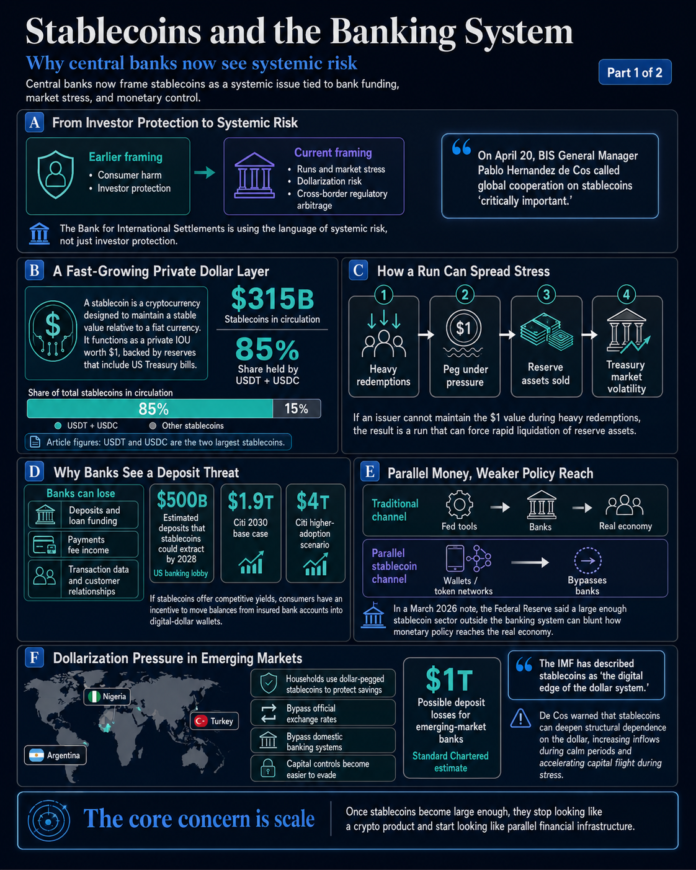
On April 20, BIS General Manager Pablo Hernandez de Cos called for global cooperation on stablecoins, describing it as “critically important.”
The Bank for International Settlements, often called the central bankers’ central bank, has raised concerns about stablecoins before, but the language they’ve used is much sharper now. De Cos warned about runs that could trigger market stress, about dollar-pegged tokens accelerating the dollarization of developing economies, and about fragmented regulatory frameworks that private firms can arbitrage across borders.
That’s the language of systemic risk, distinct from the investor-protection framing that dominated earlier debates.
A stablecoin is a cryptocurrency designed to maintain a stable value relative to a fiat currency. Tether’s USDT and Circle’s USDC are the two largest, together accounting for roughly 85% of the $315 billion in stablecoins currently in circulation.
Unlike a savings account or legal tender, a stablecoin functions as a private IOU worth $1, backed by reserves that include US Treasury bills and built for speed across borders and crypto markets. At that scale, the convenience is exactly what central banks now find alarming.
Central banks are worried about deposits, not pegs
The concern over peg stability is real: if an issuer can’t maintain the $1 value during heavy redemptions, the result is a run that forces rapid liquidation of reserve assets, injecting volatility into Treasury markets.
The deeper concern, however, is what stablecoins do to the banking system as they grow. When people hold tokens instead of bank deposits, banks lose the funding base they use to make loans. When payments settle on private token networks rather than bank rails, banks lose fee income, transaction data, and customer relationships.
The ECB has been explicit about this chain: stablecoins could cost European banks all three simultaneously while giving dollar-denominated tokens a foothold in markets where the euro is supposed to be dominant.
CryptoSlate reported on the ECB’s modeling in November 2025, when policymakers war-gamed what $2 trillion in stablecoins would mean for European financial stability. Their conclusion was that at that scale, stablecoins become a direct transmission channel for American financial stress into European banks.
Citi’s April 2026 research projects stablecoin issuance at $1.9 trillion by 2030 in the base case, with $4 trillion possible under higher-adoption scenarios. These figures are now actively shaping how central banks set their planning horizons.
The deposit question has become urgent for banks. If stablecoins can offer competitive yields, consumers have a clear incentive to shift balances away from insured bank accounts toward digital-dollar wallets, and the US banking lobby has estimated that stablecoins could extract roughly $500 billion in deposits by 2028.
The Federal Reserve, in a March 2026 note on payment stablecoins and cross-border payments, added a further complication: a large enough stablecoin sector outside the banking system can blunt how monetary policy reaches the real economy, because the Fed’s tools work through banks, and a parallel network that bypasses them weakens their reach.
The deposit drain plays out primarily in developed economies because the dollarization problem is global. De Cos warned that stablecoins can accelerate the structural dependence of developing economies on the dollar while making it easier to evade capital controls, leading to larger inflows during stable periods and faster capital flight during stress.
We’ve seen this take place in countries like Nigeria, Argentina, and Turkey, where households are already using dollar-pegged stablecoins to protect savings from devaluing local currencies, bypassing official exchange rates and domestic banking systems entirely.
Standard Chartered has estimated that banks in emerging markets could lose as much as $1 trillion in deposits to stablecoins. The IMF has described stablecoins as the digital edge of the dollar system, a phrase that perfectly captures both the utility and the structural threat.
It implies that stablecoins extend dollar dominance faster and more directly than the eurodollar system ever did, through private companies rather than state institutions, leaving central banks in smaller economies with no practical mechanism to slow the outflow.
The real fight is over who controls stablecoin movements
The debate has reached European political leadership, and the positions aren’t aligned.
On April 17, French Finance Minister Roland Lescure called the current volume of euro-pegged stablecoins “not satisfactory” and endorsed Qivalis, a consortium of European banks including ING, UniCredit, and BNP Paribas, building a euro-denominated stablecoin. Lescure also urged European banks to explore tokenized deposits, framing the initiative as a defense of European payment sovereignty against US dominance.
It’s hard to miss the tension in that position. European policymakers fear stablecoins and simultaneously fear being excluded from the infrastructure race. If dollar tokens become the default settlement layer for digital payments globally, a Europe that blocked stablecoin development domestically ends up on American rails regardless.
At the same time, the Banque de France’s First Deputy Governor, Denis Beau, has been calling for stronger MiCA restrictions on non-euro stablecoins used in everyday payments, even as Lescure endorses the technology.
Europe is running two policy tracks at once without resolving the contradiction: policymakers want the efficiency of tokenized money movement, and they’re deeply uncomfortable with private issuers controlling it.
Whether regulators ultimately treat stablecoins as payment utilities, deposit substitutes, or shadow money-market products will determine how much of the monetary system private issuers are permitted to absorb.
That reclassification is happening in real time, and the outcome will shape how money moves for the next decade.