
On Apr. 22, Bitcoin price registered an intraday high of $79,485 as broader risk assets bounced on relief from a ceasefire.
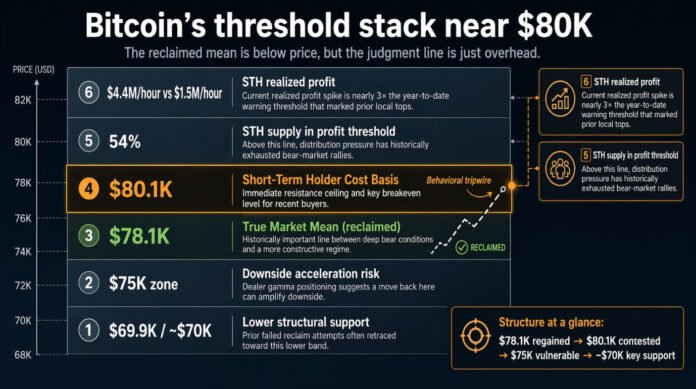
On-chain data frames Bitcoin’s (BTC) approach to $80,000 as a behavioral tripwire, a ceiling built from the breakeven psychology of recent buyers.
Glassnode says BTC has reclaimed the True Market Mean at $78,100, a threshold the firm frames as the boundary between deep bear market conditions and a regime where mean reversion is credible.
According to a recent report, Glassnode says the market faces a harder problem around $80,000, where three seller mechanisms stack on top of one another, each reinforcing the next.
The first is the Short-Term Holder Cost Basis at $80,100, the average acquisition price for coins bought in the last 155 days. That cohort is the most price-sensitive segment of the market, and breakeven converts to supply, as buyers who waited months to get flat rarely take on more risk the moment they recover their entry price.
The second is the 54% in-profit line, as a push toward $80,100 would carry the share of short-term holder supply into profit above the 54% statistical mean that Glassnode ties to peak distribution during bear-market rallies.
Once enough recent buyers are back in the money, relief converts to selling at a pace the market must absorb.
The third mechanism is that short-term holders’ realized profits have surged to $4.4 million per hour, nearly three times the $1.5 million per hour year-to-date warning line that Glassnode says marked every prior local top this year.
The market is already testing if fresh demand can absorb that selling.
The macro backdrop
Bitcoin is pressing against that overhead supply zone into a restrictive macro backdrop.
March US CPI rose 0.9% month over month and 3.3% year over year, with gasoline accounting for nearly three-quarters of the headline jump.
Core CPI came in at 0.2% on the month and 2.6% on the year, a softer read that still leaves the headline acceleration intact for any Fed assessment. The Federal Reserve cannot ignore a re-acceleration of that size in headline inflation, even as the core trend held at 2.6% year over year.
March payrolls rose 178,000, unemployment held at 4.3%, and the average workweek shortened to 34.2 hours. The results are firm enough to delay policy easing while keeping growth anxiety alive, precisely the kind of report that locks uncertainty in place for both growth and policy.
Reuters’ Apr. 22 poll of economists captures the cumulative effect of the Fed waiting at least six months before cutting rates, with war-driven energy prices keeping PCE inflation elevated at 3.7% in the second quarter, 3.4% in the third quarter, and 3.2% in the fourth quarter.
Nearly 33% of economists expect rates to remain unchanged throughout 2026. Brent crude at $100.58, US crude at $91.54, and the 10-year Treasury yield near 4.286% filled in the rest of the picture on the day Bitcoin posted its gain.
Bitcoin bounced on ceasefire relief while oil climbed alongside it, leaving the macro constraints that defined this year’s drawdown intact.
The demand picture
Farside Investors’ data show that a $291 million outflow on Apr. 13 gave way to six trading sessions totaling roughly $1.54 billion in net inflows through Apr. 21, including $663.9 million on Apr. 17 and $238.4 million on Apr. 20.
The most recent session slowed sharply to $11.8 million, showing that the bid is back and clearing overhead supply only at the margins.
Glassnode says cumulative volume delta has turned higher, with Binance leading the buying while Coinbase has stayed comparatively muted. This split puts offshore and crypto-native buyers as the primary force behind the rally, with US institutional demand comparatively quiet.
Derivatives tell a more cautious version of the same story, with funding rates staying negative across major exchanges through March and April. That positioning points out that negative funding can fuel a squeeze if Bitcoin forces a break, and it also points to a market still positioned for further downside on this move.
Meanwhile, 30-day realized volatility has fallen to 40.7% from 49% at the start of April, and the volatility risk premium has compressed to near zero, showing that options are pricing range-bound volatility.
Two resolutions for the current state
In the bull case, demand absorbs the breakeven sellers. A sustained hold above $80,100, paired with continued positive ETF flows and firm spot buying, would mean new buyers are finally overcoming short-term-holder distribution.
Because funding is still negative, that resolution could trigger a squeeze, forcing short covering and accelerating gains beyond what spot buying alone generates.
Using Glassnode’s 40.7% realized volatility, a 30-day one-standard-deviation envelope runs from roughly $69,600 to $87,900. A bull resolution draws the market toward the upper end of that band.
In the bear case, the judgment line holds. If the price stalls near $80,000 and ETF inflows stay modest, realized profit behavior is already at levels consistent with prior local tops.
A rejection from $80,100 carries specific downside risk tied to dealer positioning, as Glassnode’s options analysis shows the heaviest negative gamma around $75,000, where dealer hedging can amplify a decline.
A retreat into the mid-$75,000 area enters that acceleration zone, and the next meaningful structural floor below it is $69,900, the lower band toward which prior failed attempts to reclaim the short-term-holder cost basis have historically retraced.
| Macro input | Reading | Why it matters for BTC |
|---|---|---|
| CPI (March) | 0.9% m/m, 3.3% y/y | Hot headline inflation limits Fed flexibility |
| Core CPI | 0.2% m/m, 2.6% y/y | Softer, but not enough to change the macro tone |
| Payrolls | 178,000 | Labor still firm enough to delay cuts |
| Unemployment | 4.3% | No urgent easing signal |
| Fed outlook | At least six months before cuts | Delays macro relief for risk assets |
| PCE outlook | 3.7% Q2 / 3.4% Q3 / 3.2% Q4 | Inflation expected to stay elevated |
| Brent | $100.58 | Energy keeps inflation pressure alive |
| U.S. 10Y yield | 4.286% | Higher rates keep financial conditions restrictive |
The same volatility envelope that gives the bull case room also shows that a test of $75,000 is well within normal 7-day volatility.
Bitcoin has reclaimed the line that ended the deep bear market, and the reward for that reclaim is a harder test almost immediately overhead, owned by buyers who waited months to get flat.