
XRP gained nearly 10% over the past week, presenting a sharp divergence from the institutional sector as investment products tied to the token posted their steepest monthly outflows of the year.
Data from CryptoSlate showed the digital asset reaching a monthly high of $1.60 over the last 24 hours before pulling back to stabilize at around $1.51 at press time.
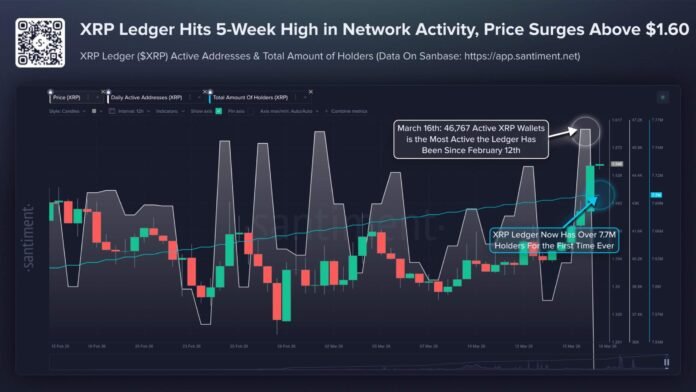
This notable market rally coincided perfectly with a massive surge in new wallet creation, an increase in daily active addresses, and a higher volume of completed payments executed directly on the XRP Ledger.
Blockchain analytics provider Santiment reported that the underlying network recently surpassed 7.7 million non-empty wallets. Additionally, active addresses on the network rose to 46,767, marking a definitive five-week high in network participation and user engagement.
Evernorth, the largest XRP treasury company, highlighted the aggressive growth trajectory of these network metrics in a recent market update.
It stated:
“XRP transactions are nearing 3M per day as of this week, up from ~1M per day in mid 2025. Nearly triple! Price moves attract attention. Activity shows where adoption is growing as more financial assets move on-chain.”
As a result, the current market environment provides traders with two completely separate signals to evaluate. The blockchain network’s usage and raw transactional utility are accelerating rapidly across the digital ecosystem, while the investments through regulated financial fund vehicles continue to contract.
Institutional investors reduce XRP portfolio exposure
Institutional interest in the digital asset has followed a completely separate trajectory from the retail spot market, with professional investors rapidly cutting their direct exposure to the Ripple-linked token.
On March 16, asset management firm CoinShares reported that XRP investment products registered $133 million in formal outflows throughout the current month. That specific volume of capital flight firmly places the token as the worst-performing digital asset within professionally managed investment portfolios during the reporting period.
SoSo Value data shows that the four United States spot XRP exchange-traded funds (ETFs) actively corroborate this broader institutional retreat. These funds have experienced a continuous outflow streak since March 5, resulting in a total capital outflow of approximately $58 million.
Notably, the current trend marks the longest continuous outflow streak since these exchange-traded products launched last November. At the present pace, XRP funds are on course to record their first negative monthly flows since their launch year.
This sharp contraction immediately follows four consecutive months of positive capital injections totaling approximately $1.26 billion.
The decline in XRP funds can be attributed to shifting macroeconomic and geopolitical factors. CryptoSlate previously reported a 93% decline in flows directed into XRP funds amid rising geopolitical tensions in the Middle East.
During this period, investors have directed consistent, substantial capital inflows into Bitcoin-related financial products. Current CoinShares data shows Bitcoin funds have attracted approximately $1.3 billion in positive inflows since the beginning of the current month.
Despite the shifting institutional landscape, Ripple continues advancing its corporate strategy across global payments, institutional custody, liquidity provision, and corporate treasury management.
The technology company recently executed a series of significant strategic acquisitions involving financial firms Hidden Road, GTreasury, and Palisade. The firm also continues to aggressively pursue regulatory operating licenses across various global jurisdictions to support its expanding XRP infrastructure.
Spot market buyers absorb institutional selling
Meanwhile, the rapid decline of institutional capital has left retail spot market investors as the primary drivers of current XRP price action.
A research note from CryptoQuant showed that XRP’s open interest is demonstrating early signs of a broader structural recovery following a period of sustained downward pressure.
Open interest across major cryptocurrency derivatives exchanges, including industry leader Binance, has trended consistently downward since the beginning of the year, sitting near its lower historical range.
A decline in open interest alongside falling or stabilizing prices typically signals a thorough unwinding of excess leverage across the broader financial market. This indicates a significant portion of highly speculative leveraged positions has successfully cleared the trading system, paving the way for more organic price discovery.
However, CoinGlass data showed a slight upward movement in the open interest during the past day to $2.84 billion.
At the same time, daily derivatives volume rose by 71% to $7.37 billion, marking the highest daily trading volume since mid-February.
What next for XRP?
Considering the above and recent price trajectory, crypto analyst Dom pointed out that XRP’s market structure on Coinbase, the largest US-based exchange, is showing the “largest bid skew within 50% seen in nearly a year.”
This means there is minimal concentration of sell orders in the $1.50 to $2.00 price range. The distinct lack of heavy overhead resistance suggests the asset price can move upward with significantly reduced friction, as fewer structural barriers exist in the order book to slow potential forward momentum.
However, for the token to achieve such upside, outflows from its four funds would need to significantly reduce from current levels.
This means the XRP ETFs must successfully recoup the approximately $58 million lost since early March to provide the necessary institutional support.
At the same time, the token would require a broader shift in macro market momentum to revive interest in alternative crypto assets. This could help revive the speculative market attention in XRP toward long-term sustainability.